One Sentence Wonders: The City’s Son

It’s my turn to join in the Great Jo Fletcher Books Giveaway, and boy do I have some wonderful stuff for you! I’ll be running a weekly competition, starting today and until the publication of my own novel at the end of March (or longer if I can persuade them to let me keep giving away books). Here’s the Twitter-friendly format:

I’ll post a summary of the book of the week, plus a thought or two about an aspect of it that I find especially intriguing. Then I’m going to ask you to tell me, in a single sentence, about your particular version of that particular reality. Examples are the best explanation, so here’s the first one:

 
untitled

Hidden under the surface of everyday London is a city of monsters and miracles, where wild train spirits stampede over the tracks and glass-skinned dancers with glowing veins light the streets.

When a devastating betrayal drives her from her home, graffiti artist Beth Bradley stumbles into the secret city, where she finds Filius Viae, London’s ragged crown prince, just when he needs someone most. An ancient enemy has returned to the darkness under St Paul’s Cathedral, bent on reigniting a centuries-old war, and Beth and Fil find themselves in a desperate race through a bizarre urban wonderland, searching for a way to save the city they both love.

Some of you might remember me raving about this book back in September; it was one of my favourite reads of 2012. Now up for a prestigious Kitschies award, Tom Pollock’s debut novel is about what it means to be part of a city, to be its blood and bones and to have it in yours. It’s a literal truth for Filius Viae, the boy with the city in his skin; and a metaphorical one for Beth Bradley, who finds sanctuary and a cause worth fighting for in the city itself, when home can provide her with neither.

So my question for you is: What makes you love your city? Post your answer in comments, or tweet it to me @scriptopus (or both!). You have until Sunday midnight (GMT) to get it in, then I’ll pick a winner. The competition is open to you wherever you are in the world, as long as your answer is in English. Prizes will be dispatched from Jo Fletcher Books HQ in London, and remember, we’ll need your address if you win.

In one sentence: What makes you love your city?  Ready, set, go!

I’m going to be on the radio! And other upcoming events.

A quick shout-out to Cheryl Morgan, who has very kindly invited me to join her on Bristol’s Ujima Radio 98fm Women’s Outlook programme from 12 – 2pm on Wednesday 27th March (podcast to follow). This is not at all coincidentally the day before Gemsigns is officially released into the wild, so we get to talk about books in general and that one in particular. It should be interesting – Ujima is largely aimed at Bristol’s Afro-Caribbean community, and I’m originally from Jamaica, so there’s an obvious link. But I don’t look or sound like what most people think a Jamaican ‘ought’ to look and sound like. Half the characters in my novel are people who are marginalised and discriminated against because of their origins, but those origins are not national, racial, religious or indeed anything else that we have experience with out here in the real world. Gender issues concern me, but only to the extent that I believe ALL issues of inequality and prejudice and presumption, ALL constraints and limitations and denials of freedom, should be of grave concern to ALL of us – whether they are constructed (or excused!) on the basis of gender, ethnicity, appearance, sexuality, religion, disability, or any of the other myriad stupid reasons we find to repress and abuse each other. So I tend not to place myself in niches because frankly, with so much nonsense to contend with on so many fronts, you need room to swing.

Then I’m at Eastercon (or EightSquaredCon as it’s known this year) in Bradford. I’m not sure exactly what (if anything) I’ll be doing as the programme isn’t out yet, but I’m told there’ll be a launch event for me and other Jo Fletcher Books authors who have novels out this spring. Anyway, if you’re there you can’t miss me; I’ll be the one floating three inches above the ground, grinning from ear to ear. And a couple of weeks later, on Thursday 11th April there’ll be what I’m grandly referring to as the London launch – basically a party in a pub with books, because with the best will in the world it’s a little too much to expect all my friends, fans, colleagues and alpha-readers to decamp to Bradford for Easter weekend (although some of them did volunteer, and I love them dearly for it). I’ll post the location once it’s confirmed; anyone who wants to come along will be very, very welcome.

Between now and the start of all that I will mostly be in Leeds, working on a very intense but short-term project to combat fuel poverty that will have me criss-crossing the Yorkshire countryside. I will be living in cheap-and-not-that-cheerful business hotels (unless I run into Lenny Henry in the lobby), which means that I should have no distractions and therefore no excuses not to write at night (I would so love to have the draft of Binary finished by the time Gemsigns is published). I will definitely be online daily (if not all day), and starting next Thursday I’ll be giving away a fantastic book every week. So it’ll be a busy-busy-busy couple of months, but it’ll be fun. Stick with me.

Housekeeping

I’m supposed to be writing today. Honest. It’s amazing how many distractions you can find to keep yourself away from doing the thing you ought to be doing and want to be doing and need to be doing. I just thought I’d spend a couple of minutes first, making a couple of long-overdue tweaks to the blog …

That was hours ago.

At a glance it won’t look much different, but behind the scenes I’ve been shifting menus around and updating categories. I started this blog over a year ago, when I was a wannabe author with neither agent nor publisher, much less a novel out at the end of next month. I’ve written extensively about that process (now categorised under ‘Publishing & Promotion’), but I hadn’t really updated the architecture of the site to reflect and support what it’s become. So today’s digression into online housekeeping is a start. I’ve created easier ways to access the extracts I post here, of which there’ll be more over the next few weeks and months; you can either look up the category ‘Extracts’ in the sidebar, or click on ‘Writing’ in the menu bar and go to ‘Novels.’ Comments are moderated now, because I have had enough of the new versions of spambot weirdness that have managed to creep through the filter (this was what set me off this morning, come to think of it). I’ve also created a contact form for anyone who wants to get in touch outside of comments.

And now, there’s a novel that’s 20,000 words short of finished and due for submission in two months. Pressing ‘Publish,’ departing WordPress, unplugging the internet …

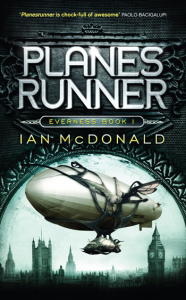
Planesrunner by Ian McDonald

There is not just one you, there are many yous. We’re part of a multiplicity of universes in parallel dimensions – and Everett Singh’s dad has found a way in.

plannesrunner1-186x300

So begins the jacket copy for Planesrunner, Ian McDonald’s first novel aimed at a YA audience. In truth it’s also a great first novel for anyone unfamiliar with McDonald’s work, or leery about novels full of heavy-duty science. McDonald builds Everett’s story around his favourite themes of quantum physics and the possibility of an infinite multitude of parallel universes; but here he goes a little slower and explains a little more than in the very adult, densely packed storyscapes of Brasyl and River of Gods, which I found indisputably brilliant, but which would probably prove more challenging reads for someone completely unfamiliar with the ideas he riffs on.

Everett’s dad is a quantum physicist and Everett is a ‘physics brat’, a kid who’s grown up so immersed in the esoteric worlds of theoretical physics and multi-dimensional mathematics that he can instinctively grasp concepts which even learned scientists struggle with. When his father is kidnapped off the streets of London right in front of him, he manages to send Everett one clue: an app on his iPad, the Infundibulum, which Everett is able to recognise as a map of the multiverse. One of the many things I love about this book is the fact that Everett is so unabashedly smart; there’s none of the apologia one often gets for that, the sense that there are negative social consequences to being really really intelligent and aw-shucks, you wouldn’t really want to be that clever, would you? Yes you would. Everett is geek to the core, but it’s made very clear that geekiness is cool, and that it does not prevent you from being good at other things too. Everett is also a star goalkeeper, and a stand-out cook.

Those interests are shared with his newly divorced dad; the descriptions of them screaming in the stands at Tottenham Hotspur matches or concocting dinners on their weekend ‘cuisine nights’ are delightful, and subtly reinforce the message that this is a normal family. The relationship between Everett and his father is in many ways the core of the book, which is interesting given that we see them together only very briefly; but Everett knows his dad and his dad knows Everett, and that closeness drives the story. Dr Singh knows Everett can work out the Infundibulum. Everett knows his dad would not have sent it to him otherwise, and therefore also knows he can do it. And that’s another thing I love; McDonald has not descended into the tired trope of angry, angsty teenager at odds with parents he doesn’t understand and who don’t understand him, which we see so often it feels as though all of literature is populated by dysfunctional parent-child relationships. No, he’s written normal: the far more prosaic – yet profound – reality that most parents and kids know each other well and love each other a lot and and have happy, comfortable lives together.

So hurrah for geeks, hurrah for ordinary, loving families, and, finally hurrah for diversity! This is not a story populated by the default Western-SF-standard of middle-class white people with a token brown or foreign person thrown in as a minor character, like a too-small dash of seasoning in a generally bland stew. Everett is a Londoner of mixed ethnicity, and the descriptions of the Punjabi side of his family are another delight. When he escapes to a gloriously electropunk London on a parallel earth in search of his father he meets Captain Anastasia Sixsmyth, her adopted daughter Sen, and the crew of the airship Everness – and finds himself part of the community of the Airish, a sky-going subculture with their own language, fashion, manners and customs. It’s a precise, insightful depiction of a different kind of caste and class system; the Airish are not defined by skin colour, national origin, religion or the other ethnic signals we’re used to, but they are nevertheless a very distinct group, and subject to very recognisable prejudices and presumptions as a result.

Despite all the fancy science and exotic scenery, Planesrunner is (like all good books) a recognisable story about kids and parents and society and challenges and relationships. It’s also a cracking adventure that jumps through worlds full of of super-cool heroes and cold-hearted villains, bizarre landscapes and alien technology, and offers up three new mysteries for every one solved. It’s the first book of the Everness series, and I can’t wait for the next one.

The Great Jo Fletcher Books Giveaway

Presents aren’t just for Christmas, so the lovely folks at Jo Fletcher Books have turned their authors into elves, with sacks of books to give away. At least four are already handing out a book a week so I’m going to hold off on mine until next month, when the flood of free fiction starts to ebb and it really does feel like the holidays are over. Until then, join in the fun with:

Naomi Foyle (@naomifoyle)

Lynda Hilburn (@LyndaHilburn)

Snorri Kristjansson (@SnorriKristjans)

Karen Lord (@Karen_Lord)

Mazarkis Williams (@mazarkis_w)

This is not an exhaustive list of elves – I gather there are at least four more slinging books hither and yon. Do keep an eye on the @JoFletcherBooks Twitter feed for even more opportunities to win. I understand that the books will ship from JFB HQ in London to wherever you are, so far-flung followers, this is your chance.

I have to mention how much I like the serendipity of the fact that this flurry of book-giving will probably culminate, quite coincidentally, sometime around World Book Night on 23 April. I’m not a giver this year, but I remain a huge fan of the event. The mission is to give literally hundreds of thousands of free books to people who normally read very little or not at all, in return for nothing more than the promise that they will read their new book themselves and pass it on to others when they’re done. And the hope that they will discover the joy and the power of reading, and do it more.

So … snag yourselves a book or two if you can, read and enjoy and share. Aren’t we lucky to live in a world where people want to give us books?

Lists

2013 is off to a good start – I appear to be getting over the latest plot-related stumbling block with Binary, and Gemsigns is popping up on a flattering number of most-anticipated lists. Here they are: 

A Fantastical Librarian: Anticipated Books (Winter/Spring) 2013: Science Fiction and Horror

Joanne Hall: Hotly Anticipated – 13 Must-Reads for 2013

Angels of Retribution: Most Anticipated Releases for 2013


What a difference a year makes

As 2012 counts down its final minutes I find myself reflecting on what an extraordinary year it’s been; not just in terms of Queen and country (Jubilee, Olympics); not just for family (one brother’s film spent the year racking up awards, another launched his debut art exhibition and had a piece selected for the National Biennial, our late mother received a posthumous parenting award from the great and good of my birth nation); but for me personally.

When the year started I was an underemployed freelance consultant who had taken the uncharacteristically irresponsible step of bunking off for most of 2011 to, of all things, write a novel. It was an itch I needed to scratch, an intellectual and artistic exercise, a labour of love. In the hope that someone besides me and a few friends might want to read it, my first task of 2012 was sending it out to agents, in the sure and certain knowledge that interest (if there ever was any) would be long in coming and publication (if it ever happened) wouldn’t happen for a good long while. I popped the packages in the post and told myself sternly to forget about it for now and get back to doing some real, i.e. pay-the-bills, work.

I’m ending 2012 with that novel less than three months away from publication, it’s sequel two-thirds written, and a third book due after that.

I think that when I tell people this was unexpected they think I’m being modest. I’m not. This has been a gobsmackingly, flabbergastingly, never-in-my-wildest-dreams sort of year.

So I want to say thank you – to the first few friends and family who said I wasn’t crazy to skive off and write, and to the wider circle who later read and commented and encouraged; to Rachel Dench who made a particular point of recommending me to Ian Drury, and to Ian for listening to the new girl in the office, reading the manuscript and offering to represent me; to Jo Fletcher for buying not just the book I’d written but two I hadn’t – yet; to Nicola Budd and Lucy Ramsey and the rest of the Quercus/JFB team for all the work they’ve done and will do behind the scenes to polish and package and promote my books and help me learn the things I’ll need to know; to the truly lovely people I’ve met in the SFF community, who are friendly and welcoming and full of lore and wisdom; and finally to everyone I’ve met, or who has stopped by the blog or the Facebook page or the intermittent Twitter feed. Everyone who’s said, ‘Wow, that sounds cool. I’d like to read that.’ You have all made this my best year ever.

Lost in translation

I’ve been extremely absent from the blog- and Twitter-spheres lately, due to a perfect storm of various seasonal maladies (hack, cough), a jaunt to London for a restorative dose of culture and companionship, and a bit (not enough) of writing. All hope of completing the first draft of Binary before the end of the year has been blown away on a bitter north wind, but at least Gemsigns is shipshape and ready to go to print. But sadly, as of yesterday it’s been confirmed that it will emerge without one line that I had really, really hoped to be able to include. Longtime readers of this blog might remember a reference I made, way back when publication was just a vague hope on the horizon, to a phrase that served as inspiration both for the story and its first working title. Well, I wanted to acknowledge the importance of that phrase, and honour the author, by using it as an epigram in Gemsigns; and I am sorry to report that after many months of chasing the necessary permissions I have had to admit defeat. But not for the reasons you might think. Along the way I’ve received an intense education on the legal complexities of licensing another’s work for reference in one’s own, particularly when different territories and publishers are involved. However, despite navigating all the contractual issues more-or-less successfully, the decision to drop it was, in the end, an aesthetic one – though deeply instructive of the commercial forces to which even the most creative of legacies is subject.

As my agent remarked, it’s no bad thing if the wider world knows what goes into getting a book from script to publication; and as my wise and wonderful publisher Jo Fletcher has already blogged eloquently and at length about exactly what happened, I’m going to repost hers here. I can’t bear to write it all up again.

This week, Beloved Reader, we are going to talk about epigrams. (There: I can see how excited you are, and all I have done is written the word.) For the avoidance of doubt, an epigram is a pithy saying or remark which expresses an idea in a clever and amusing way. I am sure you will be fascinated to know that this literary device comes from the Greek, ἐπίγραμμα, via late Middle English, and it has been employed for more than two thousand years.

More generally, and for our purpose today, it’s that quote that you find at the head of a chapter or start of a book or part of a book.

Why am I particularly interested in epigrams today? Pay attention, and you shall hear of the travails of one of my Beloved Authors – we’ll call her BA – who has Tried To Do The Right Thing.

BA wanted to use a quote from The Book of Imaginary Beings by the Argentinian writer Jorge Luis Borges, and I advised her that she would need to get permission, and to start with the agent for Borges’ estate, supplied via the Society of Authors (a font of useful knowledge for such things). Now, what generally happens here is that the copyright holder either (a) says, ‘Yay! Go for it! No fee!’ or (b) says, ‘Yay! Go for it! X pounds, please!’ And then there will be some forms to fill in, mostly dealing with how exactly we’re going to credit the writer, and that’s that. Obviously, we hope for option A, rather than B, which can work out costly (lines of songs tend to be a bit on the pricy side, for example).

In this case, though, all started well: the agent who handles Borges’ estate referred BA to the UK publisher, Random House, and it didn’t take too long for them to come back with permission, free of charge for the UK and Commonwealth, excluding Canada.

The problem is, I generally buy World Rights, which means that BA needs permission to publish this quote everywhere – but after some discussion we agreed that as long as North America was covered – as we’ll be bringing the book out as part of QUSA/JFB USA – we’d not worry about the rest of the world.

So, girding her loins once more, off BA went again, this time to Penguin in USA and Canada, respectively.

In her explanatory email to me, she said, ‘Here’s where it gets sticky.’ She is a master of understatement, this one!

The Book of Imaginary Beings was written in Spanish, so the issue is not one of just permission to reprint, but to use a particular translation: in this case by the American translator Norman Thomas di Giovanni.

Penguin US did publish the di Giovanni translation, and do control world rights outside of the UK – but their agreement with the author’s estate means they can license only a completely different translation, by one Andrew Hurley.

So yes, we can have permission, and free of charge at that – but it’s for the wrong words –because both BA and I agree that the later translation, of this sentence at least, is not as good.

To make matters worse, Penguin Canada has still not responded.

Oh, and to get the okay for electronic rights, she was told she would need to go back to the agency.

So back she went to the agent. Any vague thoughts she might have had of circumventing the North American situation by dealing direct with the agency were blown out of the water when the agent revealed that yes, she could and would let BA have e-rights, for a small fee – but only for the Hurley version!

This is the point BA came to me, and we agreed, after some discussion, that since it was clear the author no longer wanted the di Giovanni translation out there, she would step away from the epigram.

And there, I thought, we would leave it, and I would use this sorry tale of months spent chasing down the permissions to show you how hard your Beloved Authors work to make sure the books are as perfect as they can be.

But there is a post scriptum: I was checking the spelling of di Giovanni (because my copy ofImaginary Beings is mysteriously MIA) when I came across this. I am paraphrasing, but in short, Borges’ widow and erstwhile personal assistant, Maria Kodama, rescinded all publishing rights for the existing collections of his work in English – including the translations by di Giovanni, in which the author himself had collaborated – because (it appears) the translator received an unprecedented half of the royalties! Kodama herself commissioned the new translations by Andrew Hurley, which have become the standard English texts.

And now I have to tell Stephanie Saulter – for it is she – that my main reason for pulling out – that the author himself had gone off the translation – appears to be very far from the case. Still, we’ve made the decision and moved on.

The one thing I can promise you is that losing that line from Imaginary Beings will make not one jot of difference to the fantastic story that is Gemsigns, coming to a bookshop near you next spring.

Astro, the morning star

The only thing I’ve been able to think about for most of the past couple of days was an event happening thousands of miles away. As I posted a few weeks ago, my brother Astro is having his first ever art show; it debuted in Kingston yesterday afternoon. Astro is a prodigiously talented digital artist, despite having considerably greater challenges than most of us will ever have to contend with. Emails, blogs and Facebook posts, and Flickr photos are telling the story today; the opening was an even bigger success than we could have hoped. As I wasn’t able to be there (I’m in England, he’s in Jamaica, large body of water in between) I have to rely on others to tell the story. So … follow the link to Jamaica Journal for a lovely report and photo album on the event. > Astro, the morning star.

GEMSIGNS extract: Passing

Several platforms had merged into an apron where departing passengers pushed past him to get to their trains as the arrivals queued up to go through the turnstiles. Eli, lost in thought as he waited his turn to shuffle forward and place his identity pass on the scanner, started at a harsh buzzing from one of the turnstiles. A petite, remarkably pretty woman stood on his side of the barrier, the rejected pass in her hand, as she stared at the flashing light on the machine.

She looked vaguely familiar, but unlike the sense of almost-recognition he’d had with Zavcka Klist, Eli knew that what he was identifying here was a type, not an individual. It was something about her littleness and delicacy of bone structure, her excessive prettiness and the shyness with which she carried it. She stood out in a way that had become rare since the Syndrome. Even Klist did not exceed the usual height-weight-attractiveness ratios nearly as much as this woman. Yet there was something incoherent about her, some subtle counteraction to her beauty. He was no follower of fashion, but he sensed that something about her appearance was wrong.

He was struck by her hair. It was shoulder length and stylishly cut, but the dull, matt-black colour was at odds with her modish grooming and fashionable clothes. Eli felt a glimmer of satisfaction at identifying the disguise. He considered whether it was a wig or a dye job, decided on dye. A wig might slip, and besides if this woman had decided to take such a risk she’d have chosen a better wig. No, she’d dyed her hair, poured on layers and layers of light-barring pigments and fixatives to block the telltale gem glow. He wondered what colour it really was. A gentle rose pink maybe, or pale lilac.

For the briefest moment she raised her eyes to the man who was waiting for her on the other side of the barrier. He looked at least twenty years older, and better at hiding his discomfiture. His hair was receding and grey, and he wore the kind of well-cut, conservative suit that made Eli think of a banker. He had a confident, well-cared-for air. Someone used to money and privilege, universal rights and automatic respect. Definitely not a gem.

‘Must be due for renewal,’ the man said, in a voice intended to carry. Although he was looking at the black-haired woman, Eli thought the comment was meant for the turnstile guards. The one on the bodyscanner was watching the woman keenly. Those adjacent to her in the crowd took in her looks and her unease, and edged away. The woman bit her lip as she carefully lowered the pass onto the scanner again. This time a soft, welcoming tone accompanied a steady green light as the barrier gates hissed open. The woman stepped through and prodded her slim climbcase into the luggage scanner.

Intrigued, Eli sidestepped into the queue for the same turnstile to watch what happened. He was certain the woman was a gem, travelling on a forged – or stolen – norm pass. It was a serious violation, and on the face of it an irrational one. Gem travel had not been restricted since the Declaration – not yet anyway – and she would have been allowed through on her own pass.

But then she would have been recorded as having arrived in London. He could think of two reasons she might wish to avoid that. One was common to any criminal, gem or norm, who wanted to cover their tracks as they moved from city to city. The other was specific to gems who simply wanted to disappear, fall off the index of the underclass and slip into norm society. If their appearance allowed them to pass, the cleanest break with their old life was to register in a new location under their new identity.

He thought the latter was more likely in this case. There was something about the woman that seemed inconsistent with a city-hopping professional crook. Her nervousness and her companion both suggested someone unused to this kind of endeavour. He wondered if the man was a lover, a well-heeled gent past his prime but with the means and nous to attract a beautiful companion who would be grateful for the life he could offer. Such cases were not unknown; were not even restricted to the rich. It was very much at odds, he thought, with Zavcka Klist’s analysis.

The climbcase hissed swiftly through the automatic sensors, and paused rather longer at the visualisation monitor. Eli could see a guard bending down to peer at the screen. He knew this was a waste of time: the chemical sensors and hazard-recognition software were much more perceptive than human faculties. The same was true of the bodyscanners. The guards were really there to deal with the people and luggage that the machines flagged up, not to identify problems themselves. Until a year ago they had had very limited authority to intervene once the equipment had signalled acceptance, but this had been extended as part of the hodgepodge of post-Declaration protocols. Approval by the scanners of papers, person and possessions no longer guaranteed swift passage.

Which was why Eli wanted to see what would happen if – as he suspected – the woman did not set off the bodyscanner. She stepped up to and through it with a bit more confidence, and stood on the exit mat waiting for the light to turn green. No physical abnormalities then, no strange internal anatomy. The guard glanced at the monitor, then peered around it to give her a long look. Eli thought he was manually overriding the lights to keep her on the mat. He was focused on her hair. She stood perfectly still, barely breathing, still biting her lip, not lifting her eyes from the ground.

A mistake, that, thought Eli. It would be more natural to glance over at him, see what’s taking so long. He found he was holding his breath too, waiting for the guard to press a button that would make the lights flash red, to stand up and ask the woman to step aside and follow me, please. She seemed resigned to it. He could see her companion draw himself up in readiness.

  • Unknown's avatarI love stories.
    My new novel, Sacred, is all about them. Publication info will be posted as soon as I have it.

    In the meantime check out Gemsigns, Binary and Regeneration, available wherever good books are sold.

  • Upcoming Events

    No upcoming events

  • Latest tweets

  • Enter your email address to follow this blog and receive notifications of new posts by email.

    Join 211 other subscribers
  • UK edition

    REGENERATION

    The 3rd Book of the ®Evolution

  • UK edition

    BINARY

    The 2nd Book of the ®Evolution

  • UK Edition

    GEMSIGNS

    The 1st Book of the ®Evolution

  • US Edition

    REGENERATION

    The 3rd Book of the ®Evolution

  • US Edition

    BINARY

    The 2nd Book of the ®Evolution

  • US Edition

    GEMSIGNS

    The 1st Book of the ®Evolution

  • Meta