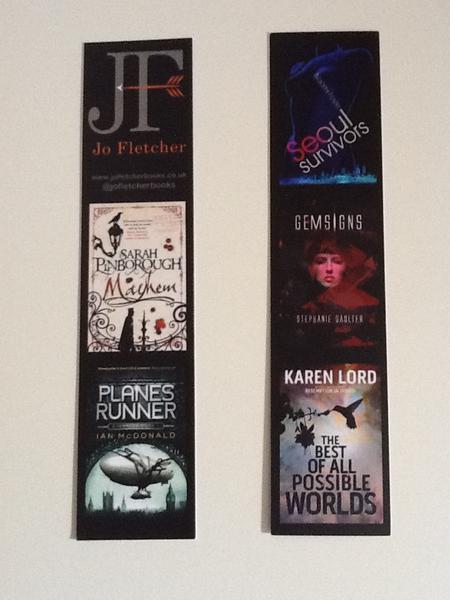
Happy Hallowe’en! Look what I got.

I’m a little old for tricks, but maybe not for treats. Remember a few weeks ago, when I was agonising over cover copy? Well the process turned out to be even more fraught than I anticipated. Turns out that the more characters and plotlines and Big Overarching Themes you have, the harder it can be to nail down just how much or how little of them should be mentioned on the back of the jacket. Fortunately, with the great Jo Fletcher for an editor/publisher, all turned out right in the end. Here’s my Hallowe’en delight, delivered just now by a mysterious messenger cleverly disguised as a servant of the Royal Mail.


The actual copy reads thus:

Humanity stands on the brink. Again.

Surviving the Syndrome meant genetically modifying almost every person on the planet. But norms and gems are different. Gems may have the superpowers that once made them valuable commodities, but they also have more than their share of the disabled, the violent and the psychotic.

After a century of servitude, freedom has come at last for the gems, and not everyone’s happy about it. The gemtechs want to turn them back into property. The godgangs want them dead. The norm majority is scared and suspicious, and doesn’t know what it wants.

Eli Walker is the scientist charged with deciding whether gems are truly human, and as extremists on both sides raise the stakes, the conflict descends into violence. He’s running out of time, and with advanced prototypes on the loose, not everyone is who or what they seem. Torn between the intrigues of ruthless executive Zavcka Klist and brilliant, badly deformed gem leader Aryel Morningstar, Eli finds himself searching for a truth that might stop a war.


Bristolcon

You ever get the guilty feeling that you’re so late with a post that it’s now too late, the thing you thought you should have written about days ago is old news, the window has been closed, the moment missed? Well I sort of feel like that. But I had too good a time at Bristolcon on Saturday not to at least acknowledge the hard work of chairperson Joanne Hall, who invited me when we met a month ago in Brighton at Fantasycon. She is clearly one of those rare people who can combine grace and good humour with ferocious organisational and timekeeping skills, as a result of which Bristolcon was fun and relaxed and went off without a hitch, at least from where I was standing/sitting/moving between panel discussions. And I met other extremely cool people and had some really interesting, stimulating conversations: shout-outs to Colum Paget (who appears to have recruited me for a hypothetical panel two Eastercons away – I’m game), Cheryl Morgan (who I think is a Bristolcon grandee, and I suspect a grandee of rather a lot, but I confess to missing details in the general hilarity), Iain Cairns, John Hawkes-Reed, Simeon Beresford, John Meaney, Gareth PowellAliette de Bodard (I came in early for a panel, caught the tail end of her reading, and became a fan; even more so when I spoke to her after and she turned out to be friendly and charming and invited me to sit at their table for lunch), and the lovely woman wearing the Neil Gaiman T-shirt with whom I shared a gushing fangirl moment along with a rather more measured chat, and whose name has since gone completely out of my head. I knew I should have posted sooner.

So be warned, those whom I will meet for the second, or even the third, time at Eastercon; it’s possible that I might get a deer-in-the-headlights look when you swan up to me with a cheery greeting. Please don’t take it personally, any more than I will when I do the swanning and you do the stricken-Bambi. I suspect it’s a condition endemic to the Cons, to be overcome only by repeated exposure.

The ASTRO Project

I’ve had a couple of non-novel-related writing tasks recently, as part of a massive family-and-friends project to support my brother Astro. He’s a very talented artist, and his first major gallery show is coming up in Jamaica next month. That would be amazing enough, but Astro is also severely disabled – now in his 30s, he was only a few weeks old when an illness caused brain damage that left him with cerebral palsy. So he has lived his entire life without any of the voluntary muscle control that the rest of us take for granted – he can’t speak, stand or use his hands. He uses adaptive technology, via a button he can press with his head, to operate a specialist computer programme. It allows him to read, write, surf the web, interact on social media, and use Inkscape and other drawing applications to make beautiful, vibrant art. It is a slow, painstaking process, requiring a level of determination and dedication that is truly humbling. I’m so proud of him, and so sorry I won’t be there to share the moment with him and the rest of the team. We’ve all gotta do what we’ve gotta do, be where we’ve gotta be, to pursue our own dreams – and at the moment mine requires me to be in a chilly old barn in Devon, making things up and writing them down. But I’ll be head, heart and spirit at Studio 174 in Kingston on 17th November, and I hope some of you will too. Here’s the link.

http://www.facebook.com/AstroMorningStar

Of giants and gentlemen

Gosh, that was fun.

I’ve been trying to figure out what my FantasyCon highlight was. There were the free books courtesy of a host of SFF major and indie publishers, and the free booze courtesy (mostly) of Jo Fletcher Books, and being introduced to the great and the good by the lovely Nicola Budd thusly: ‘Oh, have you met Stephanie? She’s one of our authors.’ There was the almost-impossible SFF trivia quiz which we came oh-so-close to winning, and the casual chat about one of my favourite authors with one of my favourite publishers, during which just enough was said about his next book to have me literally salivating in anticipation. It might have been getting to know the delightful Tom Pollock, reading (over and over) the inscription he wrote in my copy of The City’s Son or hearing him read the first chapter of its as-yet-unfinished sequel The Glass Republic; or laughing and talking literature with the equally delightful Snorri Kristjansson, whose first novel The Swords of Good Men I’m now looking forward to just as much.

But on reflection, wonderful as all those moments were, THE moment was something else. And I didn’t even know it at the time.

It was at the JFB 1st-anniversary party on Saturday night, surrounded by the beautiful books they’ve published over the past year and the beautiful bookmarks showcasing some of the volumes – including mine – coming next year. I started chatting to another of the authors whose novel Planesrunner is also featured on said bookmark. He was a convivial bloke named Ian McDonald, possessed of a thick brogue, a battered black leather jacket and amusingly wry commentary about books that do well in the US but not the UK and vice versa, for no reason that anyone can work out. There was something very familiar about him, though we clearly had never met before, and I blame the wine for me not paying sufficient attention to that fact at the time. He politely asked about me, and I gushed forth – as I’m afraid I may have done rather a lot – about how amazed and lucky I felt to be an about-to-be-published writer, how quickly and unexpectedly it had all happened, that a year ago I hadn’t even finished writing the novel whose cover art we were admiring. He blinked in what looked like genuine surprise and complimented me, something along the lines of: that’s pretty unusual, must be a really good book. So they tell me, I said, but let’s see what the punters think when it comes time to drop a tenner on it at Waterstones. And we had a chuckle, and shortly after that the currents of the party pulled us in different directions, as they do, and I didn’t see him again.

I wish I could say that the penny dropped the moment that scruffy jacket disappeared into the crowd, that waves of enlightenment parted around him and crashed over me in a well-deserved tsunami. I’m afraid it took a little longer, but I got there in the end. Ian McDonald. That’s the guy who wrote River of Gods and Brasyl, along with a host of other award-winning and -nominated books of the past twenty-odd years. The BSFA, Hugo, Nebula, Arthur C. Clarke. That Ian McDonald. Look him up if you don’t know. I did, as the penny pirouetted to a halt with a mocking tinkle. I must have not-quite-recognised him from a book jacket, or maybe from a webcast interview he did with that aforementioned favourite author of mine, talking about their respective Great Works. And he must have clocked me as an oblivious newbie, unaware of the extent of my own ignorance, and just let it go.

And that, in microcosm, was what made FantasyCon such a good experience. The warmth and welcome, the genuine enthusiasm and complete lack of pretension, the amused and kindly forbearance of the veterans for the novices. The fact that a giant of our genre was nice enough to let me prattle on, and felt absolutely no need to clue me in to who he was. To say and not say exactly the things that made me feel that I belonged there, just as he did.

Mr. McDonald, sir: I salute you. Better late than never.

FantasyCon here I come

I’m off to FantasyCon in Brighton on Friday morning. My first ever genre convention, and I’m not entirely sure what to expect. I never felt moved to go to them as a reader; I never really understood how my enjoyment of fantastic fiction was going to be increased by propping up the bar next to a costumed stormtrooper. Or an orc. One of the interesting things about becoming a writer, though, is that you find yourself having a different, and often more democratic, perspective on things. Could I, in my wildest dreams, dare to hope that one day I might go to a convention where fans dress up as characters I created? It’s very, very, very unlikely – I’ve got a better chance of being hit by lightning in this unseasonably stormy September weather – but all of a sudden it seems less a questionable eccentricity and more like the ultimate accolade.

Plus there are the educational and community aspects. I don’t feel like I’ve really found my feet yet – this whole first-book-about-to-be-published, struggling-through-the-second-book, is a weird experience. It’s so different to my former life. It seems to be going well, but how can you tell? What do you compare it to? I don’t know anybody else who does this for a living. I don’t even know if I do it for a living, or if it’s just a strange, fortuitous little bubble of time, in which I get to live my fantasy life of being a writer for a few months, maybe a year or two, before the money runs out and the books don’t sell well and I have to go back to having a proper, full-time job. Back in the real world.

So roll on FantasyCon. There’ll be pundits and publishers, bloggers and fans. But I’m particularly looking forward to meeting other writers – both published and aspiring, those who can do it for a living and those who do it purely for love. With any luck I’ll get some tips and tricks for dealing with the ups and downs, the disappointments and reversals (and – who knows? – maybe even the successes) to come. I want to know if I’m the only one finding their second novel problematic and intimidating in a way the first one never was. If I’m alone in swinging from the elation of a perfect paragraph at noon to the despair of garbled dialogue at midnight. In short, I’m hoping for the reassurance, the camaraderie, of like minds.

And maybe even an orc or two.

GEMSIGNS cover blurb

My publisher asked if I wanted to have a crack at the jacket copy for Gemsigns. This is, of course, hugely important; how many of us decide to buy a book – or not – by picking up a likely-looking volume, flipping it over and reading the back? (Or the inside flap of the jacket if it’s a hardcover.) You’d think it  wouldn’t be too difficult, but it turns out that 2-3 short, punchy paragraphs that capture the essence of the story without giving too much away, that are enticing enough to hook a prospective reader, are not simple to construct at all. I’ve read my latest draft so many times now it’s a blur. So this is an attempt to crowdsource opinion. Would you buy this book?

Image

Humanity stands on the brink. Again.

Surviving the Syndrome meant genetically altering every person on the planet. But norms and gems are different. Gems may have the superpowers that once made them valuable commodities, but they also have more than their fair share of the disabled, the violent and the psychotic. And a legacy of servitude, to which they will not return.

When the gem Gaela finds an abandoned child with an unregistered ability, events are set in motion that will drag every element of her fractured world into conflict: the vicious intrigues of the gemtech that created her, the holy war of the godgangs, and the fears and prejudices of the norm majority. Ruthless executive Zavcka Klist will do whatever it takes to retrieve little Gabriel. Deformed, unaccountably formidable leader Aryel Morningstar is hiding secrets of her own. Only norm scientist Dr Eli Walker can be trusted to navigate this treacherous terrain, in a desperate search for the truth.

Likes and/or comments much appreciated!

The City’s Son shines

I’ve just finished reading one of those books that grabs hold and hangs on and gets in your way until you’re done with it; or until it, possibly, is done with you. The kind that interrupts my own writing and even my sense of place; I’ve looked up a couple of times over the last couple of days, slightly dazed to find myself in a sunny garden in Devon instead of a wintry, smelly back alley in the Big Smoke in the company of garbage gods and warrior cats. Urban fantasies of alternate Londons are almost a genre of their own now, what with your Neil Gaimans and China Mievilles and Ben Aaronovitchs and … I could go on, but you get the picture. You’d think there wouldn’t be too many new takes on the idea, not too many opportunities to seduce a fairly jaded reader like myself. You’d be wrong.

Tom Pollock’s The City’s Son is a delight. Nominally aimed at the young adult market, I think all you have to be is young at heart to appreciate this beautifully written, cleverly constructed tale of a city whose very fabric is alive and vital – a city of sodium-light dancers and tower-crane demons and the ghosts of trains, a city where the Pavement Priests are made of stone and bronze and the Mirrorstocracy are, quite literally, no more than reflections of former glory. Into it stumbles graffiti artist Beth Bradley, fleeing tragedy at home and trouble at school, only to find herself in the company of Filius Viae, abandoned son of the city’s absent Goddess. Together Fil and Beth must find a way to save their city from his mother’s ancient enemy, Reach, the King of the Cranes. And that’s as much of the story as you’re getting from me. All I’ll say is that the outcome isn’t obvious; Pollock, like Mieville, has a fondness for turning tropes on their head. That’s not all he’s got going for him; his characters jump off the page at you, fully realised and recognisable in the space of a few words (not unlike Gaiman, and believe me when I tell you, coming from me that’s very high praise). And like Aaronovitch, the story is full of snarky humour and a palpable love of London.

Are there flaws? Of course there are, but they are few and forgivable. The speed with which Beth’s dad and best friend accept the altered reality in which they find themselves seems a bit unlikely under the circumstances. The friend, Pen, is subjected to horrific ordeals in both Londons but the one in the ‘real’ world, although an inciting event for much that happens later, is pretty much glossed over. And I found myself wondering how the cataclysmic events in the ‘other’ London were perceived and explained in ours, and why the police didn’t seem to be involved in the hunt for two missing teenage girls. In a lesser book these would have been real problems; here they are quibbles. Pollock’s prose flows so beautifully it would disguise far greater sins. I’ve read a fair few first novels recently that are long on story but short on storytelling, in which the craft of writing seems neglected by writers in love with the tale, but not the telling.

The City’s Son works the way all magic works; by paying attention to the details that seduce and misdirect, using turns of phrase and moments of imagery to channel emotion and imagination. Tom Pollock didn’t just tell a great story; he’s a great storyteller. I’m looking forward to the next one.

GEMSIGNS cover reveal!

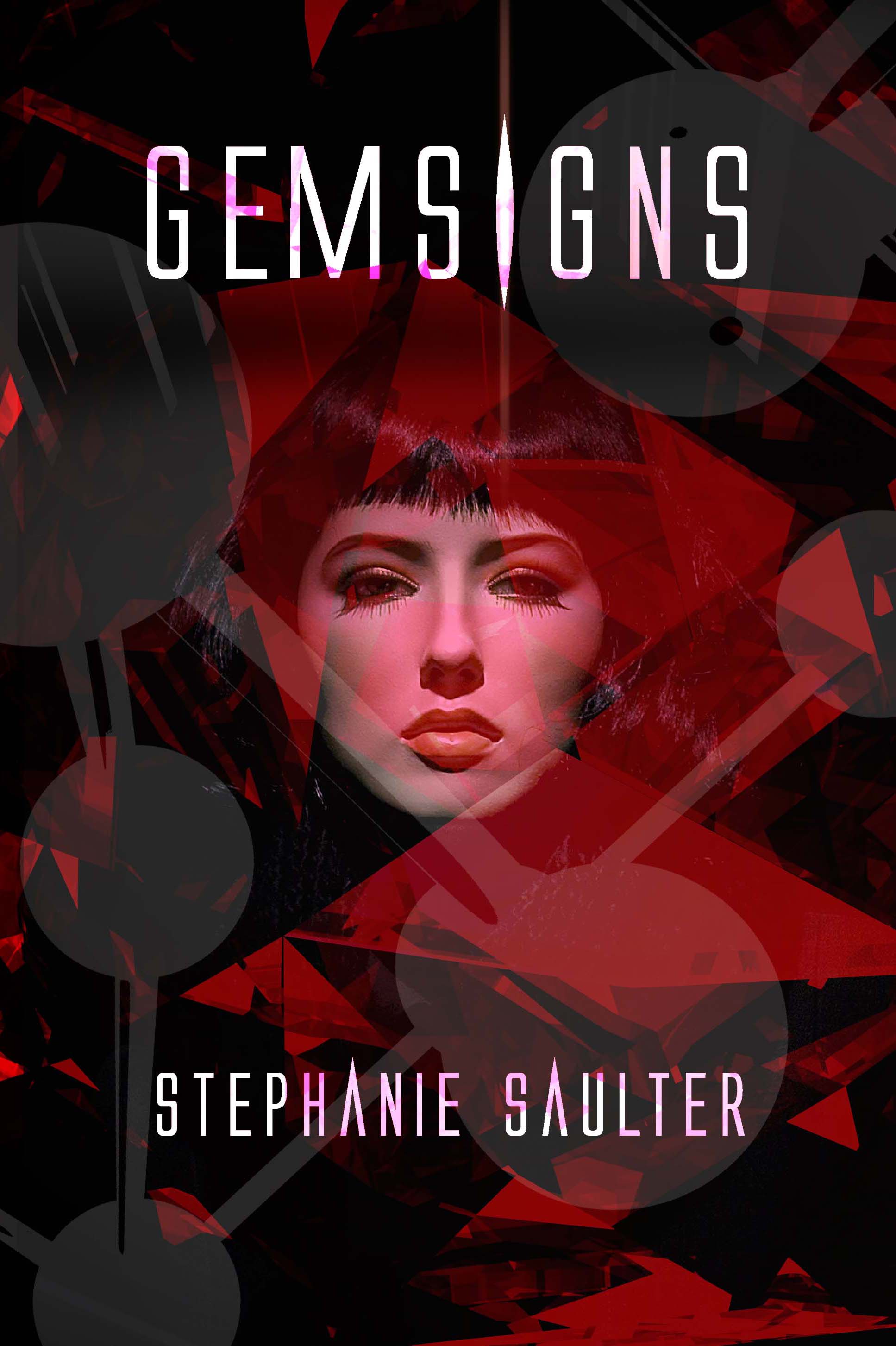
A few weeks ago I reported with much excitement on the cover meeting I’d had with Jo Fletcher Books. As I said then, the concept they came up with managed both to fit the brief perfectly and to be not at all what I expected, to reflect the story while giving nothing away. I was stunned and delighted and I couldn’t wait to share it with you. And now … I can.

The first book of the ®Evolution

Gemsigns will be published April 2013


Creating smart characters

I’ve been procrastinating this morning by browsing writing questions on Quora. Someone wanted tips for creating a character who is smarter than they are, and I was struck that most of the answers seemed to assume this must be a very difficult thing to do. Suggestions ranged from role-playing; to the Arthur Conan Doyle method (have a character of normal intelligence, i.e. Dr. Watson, describe the character of greater intelligence, i.e. Sherlock Holmes); to making the character confusing and incomprehensible; to not even attempting the task.

Now I write a lot of very smart characters, some of whom are definitely smarter than me, and I don’t find it that hard at all. You don’t need to make every line they speak or every action they take redolent of their greater intellect, unless you are actively trying to present their cleverness as the only interesting thing about them and the only reason they are in your story. Instead give them a quirk, some character trait that suggests quick thinking or the kind of specific intelligence you want to convey.

For instance: I’ve created a character who likes wordplay and aphorisms. He tends to drop them into conversation, either to amuse the friend he’s speaking to or stump someone who’s annoying him. The rest of his conversation is intelligent in an unintimidating way, but just four or five of these zingers scattered throughout the novel is enough to give the impression of a really big brain at work. Another possibility would be a prodigious memory, someone who remembers the details of things they read or saw long ago. Or you could give your character a facility with numbers – have them add things up in their head before the person with the calculator or cash register can give them the total, for example.

How you do it will depend on the type of story you’re telling and the purpose of the character in it, but think about the things that make you form an impression of someone’s intelligence in real life. It will rarely be because they suddenly start spouting the laws of particle physics or deduce what you had for breakfast from the stain on your tie. It’ll be the way in which they speak, what they do for a living, the esoteric subjects they seem to know a lot about, how insightful they are. Utilise those kinds of naturalistic cues in your writing and it will be easier to make your character’s intelligence believable.

BINARY extract: Supper therapy

It pleased her greatly that he had learnt to enjoy food, instead of treating it as no more than a tedious refuelling that took him away from his tablet and screens. They had formed an instinctive, unspoken rota back in the beginning of the Squats, making sure he had a tasty meal and company to eat it with every day if they could; prying him gently offline and into the more visceral interactions of meat and bread and touch and speech. She had watched him change over those lunches and suppers, bit by infinitesimal bit, could almost map each new word or glimmer of expression that he gained against a taste or texture that gave him pause, and fired a new, old pattern into the altered web of his brain. Some deeply buried instinct for humanity had stirred with every bite.

(Postscript: I can’t post proper extracts from Binary, not until Gemsigns is out, but no harm in the odd un-spoilered paragraph here and there. I’m quite pleased with this one.)

  • Unknown's avatarI love stories.
    My new novel, Sacred, is all about them. Publication info will be posted as soon as I have it.

    In the meantime check out Gemsigns, Binary and Regeneration, available wherever good books are sold.

  • Upcoming Events

    No upcoming events

  • Latest tweets

  • Enter your email address to follow this blog and receive notifications of new posts by email.

    Join 211 other subscribers
  • UK edition

    REGENERATION

    The 3rd Book of the ®Evolution

  • UK edition

    BINARY

    The 2nd Book of the ®Evolution

  • UK Edition

    GEMSIGNS

    The 1st Book of the ®Evolution

  • US Edition

    REGENERATION

    The 3rd Book of the ®Evolution

  • US Edition

    BINARY

    The 2nd Book of the ®Evolution

  • US Edition

    GEMSIGNS

    The 1st Book of the ®Evolution

  • Meta