Books and parties and conventions and prizes and … Calabash!

If you’ve been keeping up with me on Twitter you’ll know that I’ve mostly been having a good week. The only real fly in my ointment at the moment has been the discovery that the Scriptopus website is down, and that the company that’s been hosting it is one of the most unprofessional organisations I’ve had the displeasure of encountering in quite some time. It’s frustrating of course, and I’m a bit surprised to find myself not more angry and upset. But while some of the content may be lost, the source code is safely backed up; and if the host can’t restore it I will relaunch it somewhere safer and saner; and I have got so many happier things to think about  

On Tuesday I received my author copies of the Binary trade (TPB) and the Gemsigns mass-market paperback (MMP) editions, both out in the UK on 3rd April. Does ripping open a cardboard box to find bound books with beautiful covers full of the words that you wrote ever get old?

2 weeks to publication!

2 weeks to publication!


I doubt it. There are no posted reviews of Binary yet – at least none that I know of – but it’s in the hands of reviewers,  a couple of whom have tweeted their early reactions. I am cautiously optimistic.

Tuesday evening was the Clarke Award shortlist announcement party, which was great fun; many congratulations to the shortlisted authors (and many thanks to the kind folks who tipped me to be one of them – even though I wasn’t, the fact that you thought I might have been meant a great deal).

Still on the subject of prizes: on Thursday Jo Fletcher Books posted a list of their Hugo-award-eligible publications and Campbell-award-eligible authors. To be honest I’d given very little thought to either of these; I tend to think that if your book isn’t out in America (and mine isn’t until May), you don’t have much of a shout. But Gemsigns and I are there for your consideration, along with many other wonderful books and first-time authors, and a reminder that the nomination deadline is 31st March.

I’ve also been communicating with the Satellite4 organisers about panels and readings; there’s going to be some very good stuff at this year’s Eastercon in Glasgow, and I hope to see many of you there. 

But with the Binary TPB and Gemsigns MMP publication date only a couple of weeks away, I’ve been mostly preoccupied with getting ready. That’s meant a long overdue update to this website (cover shots and purchase links in the sidebar! actual descriptions of the novels under the Novels tab!), and to bios and avatars around the web more generally. I’ve been busiest of all with guest posts and interviews: over the next few weeks I’ll be popping up in a variety of places, including Civilian Reader, Upcoming4.Me, SF Signal, Little Red Reviewer, and Tor.com.

And I’ve been waiting on an announcement. Not an award or shortlist this time, but the official launch of the Calabash International Literary Festival in Jamaica in May. It’s been in my Upcoming Events for ages, but I couldn’t pre-empt the organisers by saying more – despite knowing enough to be very excited. So the first of my series of guest posts to go live is the last one I wrote –  SF in’a Calabash, composed this morning on the back of last night’s launch. If you never follow another link from this blog please, follow that one. It’s something I am very very proud to be part of.  

Guest post: Ways of Seeing

I’ve written about perception, presumption, and the right to be who you are for the We See a Different Frontier blog carnival, hosted by The Future Fire. I got pretty passionate. Link below:

The Future Fire editors’ blog: Guest post: Ways of Seeing.

What I thought of WFC 2013

The World Fantasy Convention 2013 is over, and as I more than hinted in the last post, I wasn’t entirely confident that it would be an enjoyable experience. In the end it wasn’t bad, as I’d feared it might be, but neither was it as good as I’d hoped. The things that went well – and from my perspective, it seemed that most things did – went very well indeed, and made me glad that I actually did go (notwithstanding starting the con and a cold at almost precisely the same moment, which meant that I drank 4 times more Lemsip than wine over the weekend). But the things that had been problematic in the run-up stayed that way, and the complaints and concerns about them were not, to the best of my knowledge, addressed during the con itself. I’m not going to restate what they were; alittlebriton did a great job of summarising here, and Tom Pollock has very ably addressed the specific issue of gender parity here. There’s really nothing I can add to either. And I do want to join Tom in expressing my appreciation for the extraordinarily hard work and dedication of the organising committee, who do a tough job for no personal compensation other than the satisfaction of seeing the con come together. I tip my metaphorical hat, and thank them most sincerely. They are decent, talented, committed people, and I hope they know that feedback is only intended to help them be even more successful next time.

Having said all that in the way of being general, let’s get specific. I was helped in this by an email I received Monday lunchtime, when I was just starting to think about writing this post. It was from another con-goer, someone who works in the industry and is, unlike me, a veteran of World Fantasy Cons. It was actually a request for feedback: What did I particularly like, what didn’t I like, and what wasn’t on offer that I would have liked to see? The following, abridged and edited for your consumption, is what I said:

GOOD:

The people. I’d made a list of who I hoped to see while there – I don’t mean the celebrities like Gaiman and Pratchett (wonderful though that would have been), but people from other countries who I’ve communicated with on social media – and in retrospect the thing I should have done was prioritise that list over anything on the programme, and made sure to meet all of them. It’s my fault that I didn’t, but even so the people-meeting, connection-making, like-minds-melding aspect of the con was my highlight.

As far as the programme went, I thought that the one-on-one Guest of Honour interviews were good match-ups, and the ones I went to or heard about from others were great fun.

LESS GOOD:

I’m sorry that this is going to be a longer section.

1.  WHO IT’S FOR. My email correspondent inadvertently helped me to identify what I think might be an underlying conflict fuelling a lot of the WFC debate; the line was ‘bearing in mind that this is a convention for industry professionals rather than fans.’ The implication being, I think, that WFC is a place for business to be done, and many of the complaints and concerns are simply not relevant to that purpose. Now I wouldn’t buy the irrelevancy argument even if that were the case, but as I pointed out in my reply, the WFC website states explicitly that it is an event ‘for professionals and fans alike.’ It seems to me that this is a real disconnect. My sense is that the professionals – especially those who’ve been around for a while – do see it as being an event that exists primarily to facilitate them in networking and deal-making, while many fans are barely aware of what constitutes the ‘professional’ side of things at all. Now I’ve got no problem with a professional event for professionals, or a fan event for fans, but if WFC says it’s for both then it needs to really be for both. Everyone’s paid to be there; no professional accreditation is required for membership (not that I’m sure how you’d define professional in this context anyway – are bloggers professional? Are all of the artists?) I don’t know whether or to what degree this professional vs. fan dichotomy is recognised as an issue at the organising committee level, so I’ll simply state the obvious: there is an equal level of obligation to everyone who has paid to be there.

2.  ACCESSIBILITY. Whether it’s for fans or professionals, or fans and professionals, WFC needs to be much more committed to providing full, uncomplicated accessibility. It’s not good enough to simply say, ‘oh, it’s an old hotel’ and throw your hands up. It is not acceptable for people who have paid their membership like everyone else, who have just as much to contribute and just as much to learn as anyone else, to be unable to access large parts of the con, to have poor to no directions on how to get to the parts they technically could reach, or for the hotel staff to whom they were referred to appear baffled by the question. And I also want to point out that disabilities and constraints are not only around mobility. If there were provisions for sight- or hearing-impaired members, for example, I saw no sign of them. (Maybe that’s because the con knew no one with those constraints would be coming. Fair enough. But is that because people with those constraints know there’s no point trying to come? That would not be fair. I don’t know which it is, but it troubles me.)

3.  COMMUNICATION. I was hoping that the programme guide issued on registration would adopt a friendlier, more welcoming tone than the website text or the now infamous e-newsletters, but unfortunately – not. All written communication appears to have been channelled through a particularly humourless 1950s schoolmistress, burdened with especially dim-witted and feckless pupils who she has the thankless task of attempting to keep on some sort of imaginary straight and narrow. This may seem trivial, but it got people’s backs up before they even arrived. No one likes feeling that they are being spoken down to.

4.  PROGRAMME. I normally love panels – they’re the thing I spend most of my time at, as a rule – but on the whole I found WFC’s pretty uninspiring. Part of the problem I, and others I’ve spoken to, had with them harks back to the communication issue – the descriptions could be downright off-putting. (I said it on the day and I’ll say it again: A panel called ‘Broads with Swords’?! Really? Really? Someone, in 2013, thought that was a good idea?!) Looking past the descriptions, very little of the content felt topical or fresh to me. Of the two themes (once I worked out what on earth they were even about – there was a page on the website that no one seems to have noticed, and the descriptions weren’t reproduced in the programme guide), Machen @ 150 felt dated and rather academic – I didn’t know why I should care – and The Next Generation felt like attempts to cover topics I’ve seen covered better, with more interesting and diverse points of view, at other cons earlier in the year. Some of the panels did end up being absolutely brilliant, but that had more to do with the collective brilliance, wittiness and knowledge of the panellists. I’m afraid many of them just felt – tired.

5.  TECHNOLOGY. The lack of free wifi in the hotel was a major problem. It made it hard for the businesspeople to do business, for members to keep track of each other, and for events to be promoted to those within and beyond the con. I promised I’d tweet, and I did try, but without wifi and with the 3G network overloaded (not helped by the howling gale that set in on Saturday) it was well-nigh impossible. I ended up sending most tweets via the free wifi in my half-the-cost-of-the-con-hotel B&B, late at night. I’d also like to suggest to WFC that – in addition to treating wifi as a mandatory requirement going forward – they  consider using one of the specialised conference apps, something like Sched or Lanyrd. They make organising con diaries so much easier, and they mean that changes to programme can be pushed out automatically. Lanyrd is also particularly effective for networking.

I’m sorry that was such a long section.

BETTER:

What would I have liked to see that wasn’t an option? Well – and especially if we are talking by professionals for professionals – how about some workshops? Seminars? Tips and techniques that working writers could take away and put into practice? (There were lots of kaffeeklatches, readings and signings; great events and I’m not complaining, but I do feel obliged to point out that they are all on the fannish side.) Neil Gaiman’s about to be a professor at Bard College; might he have been persuaded to give new and wannabe authors a sneak preview of some of his course material? Or maybe a few veterans could run a half-day, intensive, mini-Clarion experience for a lucky dozen writers, chosen by lottery on the opening day – a cool addition to the con kick-off? With such an international gathering, there’s the potential for some seriously useful, once-in-a-lifetime learning from real-life genre giants.

From Bristol to Brighton, with some trepidation

Another week, another con … I’m off to Brighton in the morning for World Fantasy and I haven’t even reported back on Bristolcon yet, apart from a series of enthusiastic tweets on the day and the day after. Well … they said it all, really. Once again Joanne Hall, Cheryl Morgan, MEG and the rest of the team did a fabulous job. My panels were fun and funny, my fellow panellists were witty and wise, and the stuff I got to go to in between was equally thoughtful, informative and engaging.

In fact my only real request is for the ‘Humans are Weird’ presentation by Amanda Kear (aka Dr Bob) to be made available online so I can go back and revisit some of the weird and wonderful facts about Homo sapiens that she unpacked for us. It was evolutionary biology for the masses, with more than a bit of cultural anthropology and behavioural psychology thrown in. There were lots of laughs, some slightly rude jokes, and genuine wonder at how a species as bizarre as we are could have made it this far, and done this well. There’s an idea circulating to maybe make Bristolcon a two-day affair … and I’m  not sure I’m in favour of that. At the moment it seems small and perfectly formed, and I’m a little nervous at the thought of messing with something that works so well.

As for WFC … well … well … I wish I could say I’m looking forward to it with equal relish, but, as this post outlines very clearly and fairly, the communiques from the Central Con Committee of Doom have been less than welcoming. In fact if I hadn’t bought my ticket a year ago on the back of the UK’s regular Fantasycon (my first con ever, and hugely enjoyable), I’m not sure I’d be going at all. But I did, and I am, and maybe it won’t be as dour and dire and downright unfriendly as it’s seeming so far. I’ll report back next week, and will be tweeting from the front line …

Where I’ll be at Bristolcon

I’m going to be up, out, and on a train at a deeply uncivilised hour tomorrow morning, but it’ll be worth it because Bristolcon! Last year it was only my second con ever; I listened to great readings and discussions, met lovely people, and thoroughly enjoyed it. This year I volunteered to do ‘stuff’ – and the stuff I got is great:

Programme Room 1  –  10am

Creating A Culture – Building A Working Fantasy / SF Society

Worldbuilding: you want to change some of the rules to make things interesting, but you still want people to buy into the world you’ve created. Rocks, trees and dragons may give you a setting, but unless your protagonist is alone on an uninhabited planet, people (human or otherwise) will have to be organised somehow. How do you set about designing an original and yet believable society? What are the most ingenious societies we’ve seen in SF&F – and what might they tell us about ourselves?

Panel discussion with Dev Agarwal (moderator), Mary Robinette Kowal, Robert Harkess, Stephanie Saulter, Peter Sutton

Programme Room 2  –  6pm

Plausible Critters    

We see a lot of creatures in SF and fantasy that are just horses or dogs in cheap disguises. Conversely, we see interesting alien life forms that are hopelessly implausible. When sticking wings on a rabbit and calling it a snoogle just won’t do, how can you create weird, wonderful and convincing critters? What are some examples of the best and worst critters in fiction?

Panel discussion with Max Edwards (moderator), Snorri Kristjansson, Stephanie Saulter, Jaine Fenn, Gareth L. Powell

Both panels are variations on a theme: the construction of a storyworld that makes a kind of intuitive sense to the reader, that is coherent and immersive enough to allow for the suspension of disbelief so crucial to any kind of fantastic fiction. So – come hear how we think it should be done and who we think does it well (or not). And in between there’s loads more to see and hear; I’ve got my eye on the Re-Telling Fairy Tales panel, as well as Comics – Art And Literature With Speech Bubbles. And of course Forbidden Planet will be there, plus the organisers have arranged a sale table for authors they may not carry. So, you know. Buy books.

The World in the City

I am again a Londoner. A Hoxtonite to be precise; a denizen of the Kingsland Road, a drifter along Pitfield Street, a haunter of Shoreditch. It’s not surprising that London inspires so many tales of its alternate selves. The names of the city are a language ripe for linkages and construction, a thousand stories begging to be told. Queensbridge runs alongside Kingsland, within shouting but not touching distance. London Fields are full of flowers, pressed hard between the Blackstone Estate and the Overground line. I followed Goldsmiths Row into Haggerston Park the other day, and stepped from city to woodland as through a portal. My path led round the back of Hackney City Farm, the smell of manure reminiscent of the stables across the field from my old home in Devon; the sounds of traffic and the voices speaking a dozen languages in a hundred accents less so.

Around a corner and into the open, and a tiny boy, Turkish I think, shrieking with laughter as he practiced his Usain Bolt sprint between delighted parents. His mother’s tight jeans and hijab were closer by far to my leggings and trailing scarf than the jilbabs of the two Somali women, gossiping behind their pushchairs. Acres of playing fields in the heart of the city, full of a thousand shades of children. Worlds do not so much collide in London as fade into each other, between the shadow of one cloud and the next.

I’m so happy to be back.

One week to go …

… Before the movers arrive, the last boxes are packed and then packed off, the furniture is wrapped and removed, and I am left, broom in hand, to flick the dust from what will shortly no longer be my house. By this time next Saturday I should have disposed of the rubbish, relinquished the keys, and be London-bound once more.

I’ve loved many things about living in Devon; the past three years have been a great time in my life, and it took half the winter, all of spring and a third of summer for me to decide to leave it behind. It was a growing sense of isolation that did it, a feeling that, for all its natural beauty and the neighbourliness of the natives, I was simply too far away from the people and places that matter most to me. I was feeling distant and disconnected. Being able to stay home and write all day sounds great – and it is – but when the only conversations you partake in for days on end are between your own characters instead of with an actual living breathing human, you can start to feel a bit removed from the world. It turns out that it’s possible to live too much inside your own head.

So I bit the bullet, sold the house, and back to the Smoke I go. I’ll be living in a flat a third the size of this place, job-hunting for the first time in five years (yikes!), learning how to juggle writing with full-time work, and otherwise re-engaging with city life. And the truth is, I’m really looking forward to it. But Westacombe Barn will always have a special place in my heart; I was as close to burnt out as I’ve ever been when I came here, but I rested and refocused, I wrote two novels, I found my muse and recharged my mojo. This is that place, and it is precious.

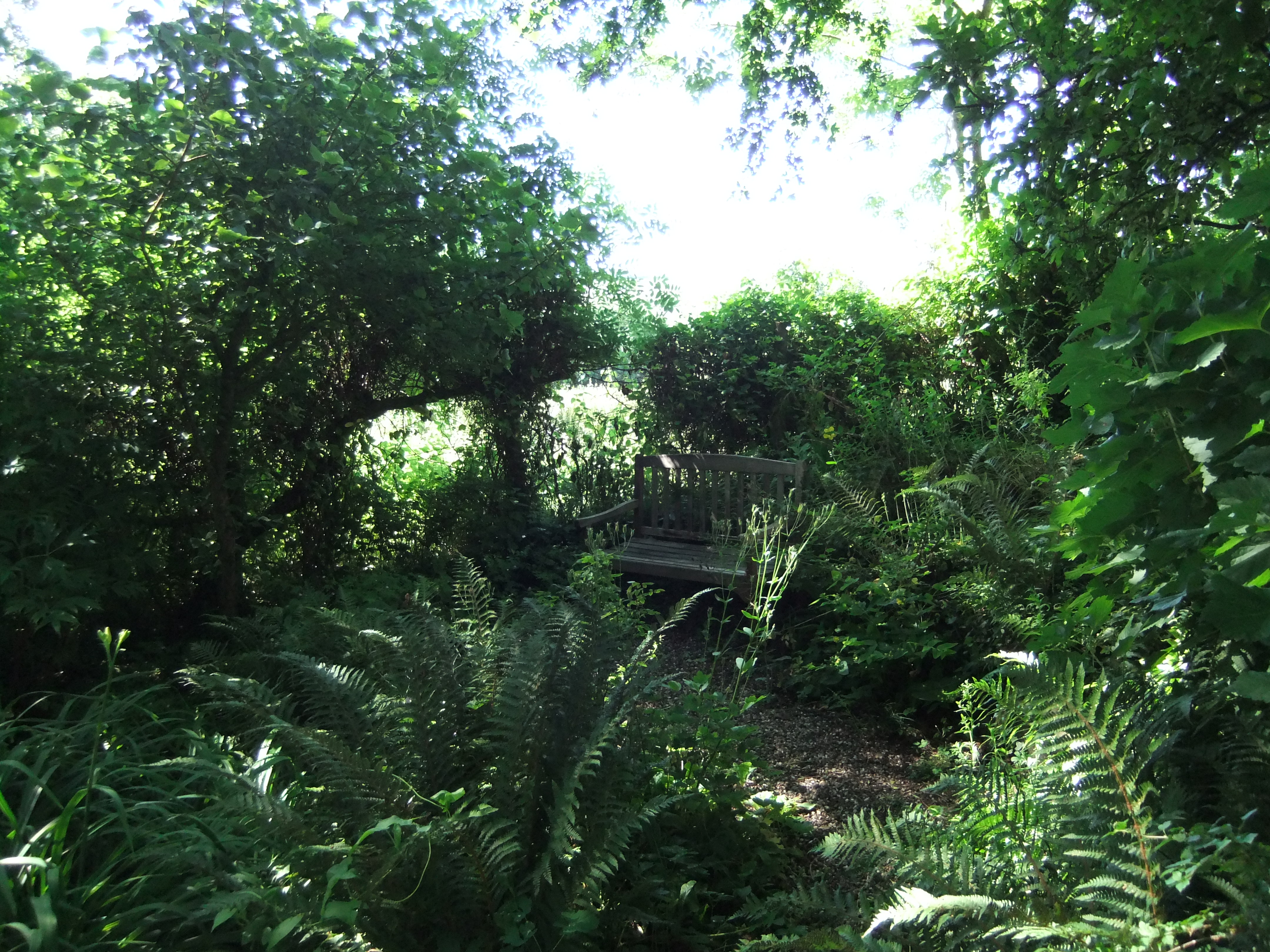
The forest garden

DSCF0409

The sun garden

Westacombe sun garden

The sun room, where much of Gemsigns and Binary were written.

DSCF0674

Heard it on the radio

I was going to write a quick post with a summary and links to the podcasts for yesterday’s Ujima Radio appearance in Bristol, but since my wonderful host Cheryl Morgan has already done so on her site I’m going to save myself the trouble and just reblog hers. Thanks again Cheryl, and Paulette and Jackie and Judeline and Mark (who was Tech Guy so you won’t hear him on-air, but lovely and clever nonetheless).

Today on Ujima | Cheryl’s Mewsings.

Well that was a busy day. Huge thanks to Stephanie Saulter for being a fabulous guest on the show. I seem to have monopolized most of the two hours this week. Here’s what went down.

The first half hour was all about Stephanie. We talked about her trip home to Jamaica to launch Gemsigns. We talked about her experiences at the Nine Worlds convention over the weekend. And we talked about the current state of affairs in Jamaica, which ranged from the economy to Usain Bolt and Chris Gayle to the horrific transphobic murder of Dwayne Jones.

The Nine Worlds coverage include shout outs for Hal Duncan, Rochita Loenen-Ruiz, Tade Thompson and quite likely a few other people. I also got in a mention of the fabulous new @WritersofColour Twitter account, and my friend Nikesh Shukla, who has a great article on their blog today about how brown people get used in movies.

In the second half hour I talked to Hannah Lawton, a young Bristol lady who, with her friend Jessie Van Beck, will be rowing across the Atlantic for charity this December. This is part of the Talisker Whisky Atlantic Challenge. You can read more about Hannah and Jessie, and why they are undertaking this grueling challenge, here.

The first hour of the show is now available as a podcast here.

Hour two begins with the Lighter Look at Life segment, which this week was all about proverbs and grammar and, well, it rambled a bit. And I think we might have got a bit confused between Axioms and Maxims. Stephanie and I both feature.

Then after 15 minutes we have the Woman of the Week slot, in which I talk to Stephanie about her life, her amazing family, and how a girl from Jamaica with what might have been the best job in the world ended up in the UK and becoming a science fiction writer.

Finally we have 15 minutes on summer reading, including Jackie’s kids being charming about their love for Harry Potter and The Hunger Games. Between us Stephanie and I managed to recommend Nalo Hopkinson, Ian McDonald, Karen Lord, Juliet McKenna, Jon Grimwood and the whole of the World Fantasy Awards Best Novel ballot.

The second half hour is available as a podcast here.

Nine Worlds Wash-Up

As trailed in the last post, I spent the weekend at the inaugural Nine Worlds Geekfest near Heathrow. I said at the time that I was optimistic about the organisers being able to pull off the majority of their wildly ambitious multi-track programme reasonably well. In the end, it was even better than I expected.

The big thing that really deserves to be bigged up is just how truly inclusive it was. I had flashbacks to Danny Boyle’s lump-in-the-throat catchphrase from the 2012 Olympics opening ceremony: ‘This is for everyone.’ When a gathering of geekdom welcomes and facilitates (and acknowledges the crossovers between) players of muggle Quidditch; the full spectrum of LGBTQ+++ persons, interests and issues; fierce feminists; middle-aged and mostly male My Little Pony enthusiasts; steampunk cosplayers; parents with kids; knitters of swords, spaceships and dragons; writers, academics, bloggers and filmmakers; and, and everybody else – well, you know you’re in the presence of something very special. Against the occasional muttering that there was perhaps just a tad too much going on, I’d have to say that for many of the people who came it was probably a pretty rare opportunity to let their particular geek/freak flag fly in a safe space. And that, I think, has immense value. I was so proud to be a part of it.

The con loaded the 400+ items on the programme onto the Lanyrd app to provide attendees with a way to keep track of events. It integrates with Twitter and LinkedIn and works brilliantly on iPad and iPhone. I liked it a lot – if the Loncon3 organisers haven’t settled on their solution for individual schedules/profiles yet, they could do worse than to check it out.

I’d hoped my first item on Friday would be the Cake or Death panel, but by the time I got there it was beyond standing room only, and the army of cheerful volunteers, who kept things running smoothly throughout the con, cheerfully kept latecomers out. So I went to the Tea and Consequences fanfic welcome session instead, met the lovely Kate Keen who was running it, confessed my total ignorance of fanfic, and was given bespoke tea and delicious cakes and inducted into the mysteries. Next up was the Jo Fletcher Books double-trouble launch party for Snorri Kristjansson’s Swords of Good Men and Tom Pollock’s The Glass Republic (both of which have of course been added to the teetering pinnacle of my own Mount To-Be-Read). Mead flowed, along with wine and good cheer, and a grand time was had by all. Finally for Friday was the New Voices Slam Session: five-minute readings from nine new authors, including yours truly. It was emceed (when did that become a word?) by Hannah Chutzpah, on secondment from running the Creative Writing track, who suggested that since the Slam had been my idea maybe I’d like to go first – and I did – and it was great. I read a particularly crunchy scene from Gemsigns, and had a blast doing it. Then I got to sit back and enjoy readings from Adam Christopher, Emma Newman, Barry Nugent, Danie Ware, Jennifer Williams, Liz de Jager, Rochita Loenen-Ruiz, and Lou Morgan. And you know what? There wasn’t a dud in the bunch. I don’t claim to have brought home all their books (too many! too many!), but they all sounded like cracking reads.

I wasn’t on the program on Saturday, which was a blessing since I’d only managed a couple of hours sleep. It also meant I got to go listen to lots of clever people talk about things variously amusing, interesting, and important (often all three). The day started with the Heroes vs. Villains debate (hilarious, and oddly insightful), followed by Why is the Future so Binary? More futurist speculation followed, with Is the Future Utopian or Dystopian? as determined by a stellar panel of SF authors.  Then a real quandary, as there were no less than four things on at 3.15 that I wanted to go to – in the end I plumped for New House Old Ghosts: Reinventing Mythology and the Supernatural, moderated by my very own editor/publisher Jo Fletcher. I followed that up with Women’s Worlds: Feminist Utopias in Literature which was particularly interesting following the earlier utopia vs. dystopia discussion, and continued the theme (sort of) with the Gender & Sexuality in SFF panel. Then I crawled away into the night to find food, came back fortified, hung out in the bar for a bit, and finally made my way, wine in hand, to the second New Voices Slam. Managed by Paul Cornell this time, with readings in alphabetical order by author, it featured Catherine Banner, Chris Brosnahan, Zen Cho, Laure Eve, Francis Knight, Snorri Kristjansson, Den Patrick, Tom Pollock, and Tade Thompson. And again was fabulous. Tom does an amazing runaway train (okay, Tom possibly is a runaway train), and Snorri’s drunken Viking pig farmer was worth the price of admission all on its own.

And finally Sunday, with no decisions to make about what to attend since the con had kindly put me on the programme all day. First was the gloriously named Can’t Take The Sky From Me: Science Fiction & Space Travel panel discussion, moderating Adam Christopher, Jaine Fenn, Gavin Smith, Charles Stross and Ian Whates. They were thoughtful and clever, and we had what turned out to be (for me anyway), a deeply interesting discussion on the imaginative possibilities and pitfalls, the technical challenges and thematic opportunities, and the literary evolution of stories set in space. I think I did all right as moderator; the questions I’d prepared kept the ball rolling, I made sure everyone contributed, we kept to time, and  got a lot of really astute audience questions in too. They were a great panel and I’d happily have many more chats with any or all of them, with or without an audience.

Can I say that a panel was great if I was on it? Next up was Racefail 101, moderated by Anne Perry, with Zen Cho, Rochita Ruiz, Tade Thompson and me. It was an incisive and pretty fearless discussion, very much in keeping with the spirit of the con, and I was incredibly impressed by my fellow panellists. We talked about historical baggage and cultural tropes, why they persist and the damage they do, and the barriers (for both readers and writers) of expectation, indoctrination, and fear that make it so hard to tear them down. Anne has summed it up nicely here, and has included the books we all recommended. Zen got to Karen Lord before I did, and my remaining recommendations are perhaps not obvious; but I wanted to give a shout-out to three straight, white, middle-aged men, because I worry that if our examples are only ever authors of colour/colonialism/some other form of otherness, we will perpetuate the myth that no one else can (or should try to) write realistic characters who are unlike themselves. So my picks are Neil Gaiman, Ian McDonald and Richard Morgan, who I think are shining examples of working hard to write race right. Once again the audience were deeply engaged, and contributed hugely to the discussion. The lesson: we can fix anything if we’re prepared to talk about it. We can’t if we’re not.

After Racefail I sat and signed at the Forbidden Planet table for an hour, and met and had long chats with lovely people, as you do. I shared the slot with Jonathan Green, who I hadn’t met before, and who I still ended up not talking to nearly enough because of all the other people we both had to talk to. So if you read this Jonathan, hello! I don’t normally break off half-way through every other sentence. And many thanks to Danie Ware and her FP colleagues for organising everything.

Last but by no means least, Rochita and I led a workshop on Writing the Other; and once again, in the spirit of the con, although it was nominally part of the Queer track, it was by no means limited to othernesses of sexuality and/or gender. We got very close to the maximum of 18 participants, many of whom I’d seen at Racefail and other panels; most were writers, one was a teacher, another a librarian, all interested in examining and improving their own reading and writing habits. Three of the four exercises were pulled from a longer workshop and accompanying guidebook of the same name, devised and authored by the American writers Nisi Shawl and Cynthia Ward, which Rochita had completed some time before. The fourth was a test of perception and presumption that I invented. They all went really well, I thought. We ran twenty minutes over, which was probably due to a combination of trying to cram too much into the time available, and the knowledge that it was the end of the con and the last item of the day for most of us. I really enjoyed doing it, but if I were to attempt it again I think it would need to either be a full ninety minutes, or fewer exercises and more time for discussion of them.

And that was almost it; a few books to buy, a few people to say goodbye to, a hasty cup of tea, and the 200-mile drive back to Devon rounded out my day. But I can’t leave Nine Worlds without huge thanks to both Jenni Hill, who ran the Books track, and Tori Truslow, who did the same for the Queer track. Sound the trumpets, toss confetti, give speeches in their honour. They are phenomenal, and they made my con.

<<<>>>

P.S. No rest for the weary, let alone the wicked. Part of the reason I’ve been so detailed in my reportage here is – apart from the fact that I want to have a record of all the things I did and as many of the people I met as possible – that I’m going to be talking about it all tomorrow with Cheryl Morgan on Bristol’s Ujima Radio (98FM) at 12noon. Podcast to follow, but do tune in if you can – nothing like hearing someone lose the thread live on air!

Nine Worlds News

Where have I been, where have I been?

Enjoying that rarest of phenomena, a proper British summer; selling my house (big moves afoot! more in a future post); rereading the Binary draft, collating thoughts — editor and agent, the ®Evolution Readers, and my own (again, lots of material for its own post here) — and commencing my own edit; all interrupted, for the past 36 hours or so, by a visit from the norovirus (who knew you could get the winter stomach flu in the summer?!?); and getting ready for the NineWorlds Convention, now only two and a half weeks away.

I jumped on the Nine Worlds bandwagon when it was running its Kickstarter back in February. The organisers billed it as ‘an unconventional convention’, with multiple tracks to accommodate all fans of the fantastic; from comics and cosplay, to gaming and Game of Thrones, to films and fanfic, to academia and, of course, books. If I’m honest, the thing that had me most worried was the sheer enormity of their ambition – could a first-time convention put together by a bunch of fans actually pull off something on this scale? But I made my pledge anyway, because I prefer grand ambitions to puny ones, and because I was really impressed by the con’s commitment to being thoroughly diverse and completely inclusive; to internalising the full breadth and depth of fandom, and making the event a place where everyone is welcome and safe, and no one feels marginalised. That, I thought, was well worth a punt.

I’ll report back after the event, but on both fronts the signs are good. The number of tracks is frankly mind-boggling, and they all seem really well programmed. The guest list is, to say the least, impressive. And judging by that programme and those guests and the regular bulletins we’ve been receiving, they’re doing what they promised and making it a con for everyone.

My appearance schedule looks like this:

  • Friday 9th August, 10:15pm: NEW VOICES SLAM SESSION. Short readings from nine of science fiction and fantasy’s most promising new authors! (Full disclosure – I suggested this one to the organisers, because there are always more authors wanting to read than can be accommodated, plus it’s hard for new authors to pull an audience on their own. So if it tanks, blame me. But it won’t. It’ll be great. I can’t wait. It’s on Saturday night as well, with a different line-up — go to both.)
  • Sunday 11th August, 10:15am: CAN’T TAKE THE SKY FROM ME: SCIENCE FICTION AND SPACE TRAVEL. It’s over fifty years since we sent the first humans into space. Are we still as excited about going to the stars? How have real-world concerns about the reality and practicality of space travel affected the genre? I moderate Charles Stross, Adam Christopher, Jaine Fenn, Ian Whates and Gavin Smith.
  • Sunday 11th August, 11:45am: RACEFAIL 101. The panellists discuss colonialism, xenophobia and racism in science fiction and fantasy, recommending the best works discussing these issues as well as discussing the problems we face in writing and reading SFF and what we can do about them. Anne Perry moderates me, Zen Cho, Rochita Loenen-Ruiz, and Tade Thompson.
  • Sunday 11th August, 1:00 – 2:00pm: BOOK SIGNING. I’ll be racing from Racefail to the Forbidden Planet table to sign copies of Gemsigns – do drop by for a chat and a scribble.
  • Sunday 11th August, 3:15pm: WRITING THE OTHER. Last but by no means least, I’m joining Rochita Loenen-Ruiz to run this workshop as part of the Queer stream. The thinking is to follow on from some of the themes of the Racefail panel, looking broadly at issues of inclusion, diversity, and social justice in addition to the core LGBTQ focus. I’m told that signups are essential for this one; email queer@nineworlds.co.uk.

In addition, I’m definitely going to the launch party for Tom Pollock and Snorri Kristansson‘s new novels (The Glass Republic and Swords of Good Men respectively) at 8:30pm on Friday; to the panel on gender and sexuality at 8:30pm on Saturday; and then to the New Voices Slam at 10:15pm Saturday, assuming I’m still vertical. In between all of that I shall be spinning around like a top, trying to work out how to take in all the other great events.

Nine Worlds is being held at the Radisson and Renaissance hotels near Heathrow. Tickets are still available here, and you can follow them on Twitter; the event-wide handle is @London_Geekfest, the Books track is @booksnineworlds, the Queer track is @NineWorldsQueer, the Writing track is @9WorldsWriting … and there are more. Did I mentioned I’m impressed? I’m impressed.

  • Unknown's avatarI love stories.
    My new novel, Sacred, is all about them. Publication info will be posted as soon as I have it.

    In the meantime check out Gemsigns, Binary and Regeneration, available wherever good books are sold.

  • Upcoming Events

    No upcoming events

  • Latest tweets

  • Enter your email address to follow this blog and receive notifications of new posts by email.

    Join 211 other subscribers
  • UK edition

    REGENERATION

    The 3rd Book of the ®Evolution

  • UK edition

    BINARY

    The 2nd Book of the ®Evolution

  • UK Edition

    GEMSIGNS

    The 1st Book of the ®Evolution

  • US Edition

    REGENERATION

    The 3rd Book of the ®Evolution

  • US Edition

    BINARY

    The 2nd Book of the ®Evolution

  • US Edition

    GEMSIGNS

    The 1st Book of the ®Evolution

  • Meta